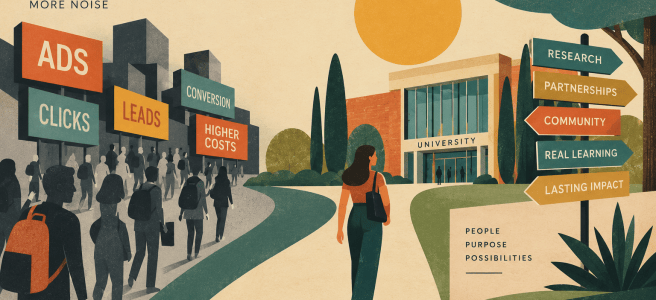
What if the problem with the rising cost of online student acquisition isn’t simply that acquisition has become more expensive, but that universities and OPMs keep acquiring students in much the same way?
A recent exchange with Neil Mosley got me thinking about the orthodoxy that has developed around online student recruitment.
Why is student acquisition getting harder?
The economics of online student recruitment have changed.
When online higher education was a less crowded market, being online was itself a point of differentiation. That advantage has largely disappeared. Prospective students now face a huge range of online degrees, short courses, microcredentials, bootcamps and professional learning from universities and commercial providers around the world. At the same time, many institutions are pursuing the same audiences through the same digital channels. The result is market saturation and an increasingly expensive competition for attention. More providers are bidding for the same search terms, advertising inventory and prospective students, while the proliferation of similar-looking online programmes makes differentiation harder.
AI potentially intensifies this in two ways.
First, it dramatically lowers the cost of producing marketing content. Institutions can generate more adverts, landing pages, emails and social content, but so can everybody else. More content doesn’t necessarily create more attention. It can simply create more noise. Second, AI is changing how people discover and evaluate educational options. Prospective students can increasingly ask an AI tool to compare programmes, explain career routes or recommend ways to acquire a skill rather than clicking through pages of search results. That potentially disrupts the traditional search-to-landing-page funnel on which much performance marketing has been built.
So universities and their partners in programme management face an uncomfortable combination: more providers, more programmes, more content, more competition for attention and potentially less predictable routes to discovery.
Yet the dominant acquisition playbook remains remarkably familiar:
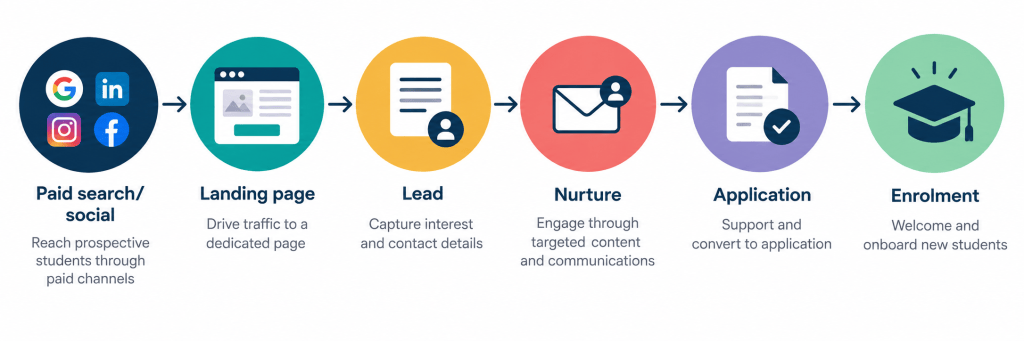
There’s nothing inherently wrong with any of those things. But when a growing number of institutions use broadly the same channels, tactics and messages to reach broadly the same audiences, we create an expensive competition for attention.
The response to rising acquisition costs is often to optimise the existing funnel: improve the creative, refine the targeting, tweak the landing page, increase conversion. Perhaps we need to ask a bigger question – what if the funnel itself is the problem?
From buying demand to building demand
Universities have assets that many commercial organisations would love to possess: academic expertise, original research, alumni networks, professional credibility, employer relationships and communities of students.
Yet we often separate these from student acquisition and then spend significant sums buying access to audiences elsewhere.
Imagine an online MSc in Sustainability. Instead of beginning with adverts for the MSc, the university could build a professional community around the challenges sustainability leaders are grappling with now: regulatory change, reporting, AI, green skills or supply-chain transition.
Academics could run quarterly research briefings. Alumni could contribute practitioner perspectives. Prospective students could join an open masterclass or tackle a short authentic case drawn from the programme.
When someone eventually considers postgraduate study, their first encounter with the university hasn’t been an advert. They’ve already experienced some of its intellectual value.
Recruit around problems, not programmes
Universities and OPMs also tend to organise recruitment around their own product architecture. The prospective student probably doesn’t.
Someone searching for help moving into educational leadership, transitioning into data science or responding to AI in their profession may not yet know whether they need an MSc, MBA, PGCert, microcredential or short executive course.
Rather than starting with:
“Study our MSc in X.”
We could start with:
“What are you trying to change in your career or practice?”
That has implications beyond marketing. It suggests building audiences around professional needs and then helping people navigate towards the right educational proposition. One relationship might therefore lead to a short course today, a postgraduate programme in two years, and executive education later in someone’s career. That is a very different conception of student acquisition.
Let people experience the product
There is another peculiarity in online education. We are selling a learning experience, yet prospective students often get remarkably little opportunity to experience the learning before making a significant financial commitment. Universities could expose much more of the intellectual experience.
Not another generic promotional webinar, but an actual piece of learning: a live seminar with an academic, a two-hour case challenge, a simulation, a short asynchronous unit, or an opportunity to receive feedback on a real professional problem. For a high-quality online programme, the learning experience itself should arguably be one of its most powerful acquisition tools.
Use networks rather than continually renting audiences
There are also opportunities through employers, professional bodies, sector organisations and alumni.
A university launching an online programme in healthcare leadership, for example, could spend heavily competing for healthcare professionals through paid search. Or it could develop relationships with NHS organisations, professional networks, employers and alumni who already have trusted access to precisely that community. These approaches aren’t free. Community building, partnerships and excellent content require investment and capability. But they create assets that can compound over time rather than disappearing when the advertising budget stops.
This changes the economics of scale
This matters particularly when institutions pursue low-price, high-volume online models.
Reducing price means needing more students to generate the same revenue. But recruiting those additional students doesn’t necessarily become proportionately easier, or cheaper. In a crowded market, the marginal student may actually become more expensive to acquire.
That creates an uncomfortable landscape:
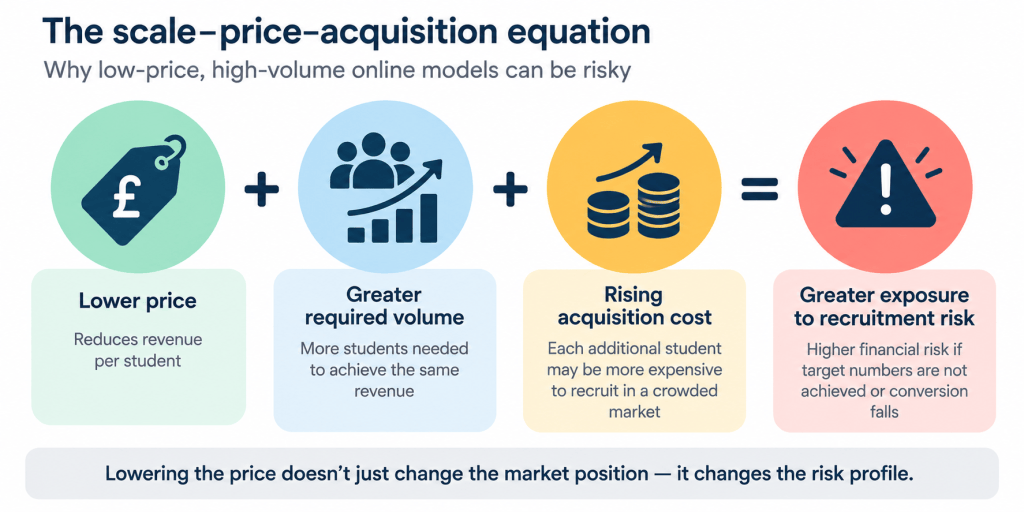
It is why I think student acquisition cost needs to be understood as more than a marketing metric.
- Programme distinctiveness affects it.
- Academic reputation affects it.
- Student experience and referrals affect it.
- Portfolio design affects it.
- Employer relationships affect it.
- Brand affects it.
- Community affects it.
And in this context retention really matters, because scale built on expensive acquisition and poor persistence is hardly sustainable scale.
This isn’t a cost-free alternative
None of this means universities can stop investing in student acquisition. Building communities, producing high-quality content, running open learning experiences and developing partnerships all require people, time, technology and investment. But there is an important difference. Much of this activity can be aligned with work universities are already doing: academics sharing research and expertise, engaging with professional communities, building employer relationships, developing learning experiences, working with alumni and contributing to public and professional debate.
Rather than student acquisition being a separate activity happening somewhere “over there”, with marketing teams purchasing attention and academics brought in largely to provide content, it becomes more closely connected to the academic life of the programme.
That could also give programme teams greater agency over how their programmes are positioned and who they are trying to reach. Academics understand the intellectual proposition, the professional communities surrounding their discipline and, often, the questions prospective students are actually trying to answer.
The opportunity is not to transfer recruitment to academics. It is to bring academic, marketing, recruitment and partnership expertise together around a shared understanding of the audience and proposition.
The investment doesn’t disappear. But more of it builds institutional capability, relationships and reusable assets, rather than simply purchasing the next lead.
So perhaps the strategic question for online education isn’t simply how can we reduce student aquisition costs it is how can we build propositions, audiences and ecosystems that make us less dependent on purchasing demand in the first place?”
That feels like a much more interesting challenge for the next phase of online higher education.


